



As part of Alpha Capital Partners’ work in administrative disputes and punitive administrative decisions, a judicial ruling was issued in favor of one of the firm’s clients, resulting in the annulment of an administrative decision imposing a fine of SAR 192,000 in connection with a violation related to the cultivation of green fodder.
The significance of the ruling lies in confirming that the legality of an administrative sanction does not depend solely on whether the violation is substantively established. It also requires compliance with the procedures and safeguards mandated by law before the penalty is imposed, particularly investigation procedures, hearing the alleged violator, and enabling that person to present a defense.
Investigating the alleged violation, hearing the person concerned, and enabling that person to present a defense are fundamental safeguards that must precede the imposition of an administrative sanction.
From the Principles of the Judicial Ruling
Investigation and Hearing as a Fundamental Safeguard
The court examined the rules governing the detection and investigation of violations under the Agriculture Law and the procedures required by its executive regulations. These include documenting the violation, investigating the person responsible, hearing that person’s statements, enabling the presentation of a defense, and recording the process in official reports.
The ruling confirmed that these procedures are not merely formal steps that may be disregarded without consequence. Rather, they constitute fundamental safeguards that must precede the imposition of an administrative sanction.
Effect of Procedural Violations on the Administrative Decision
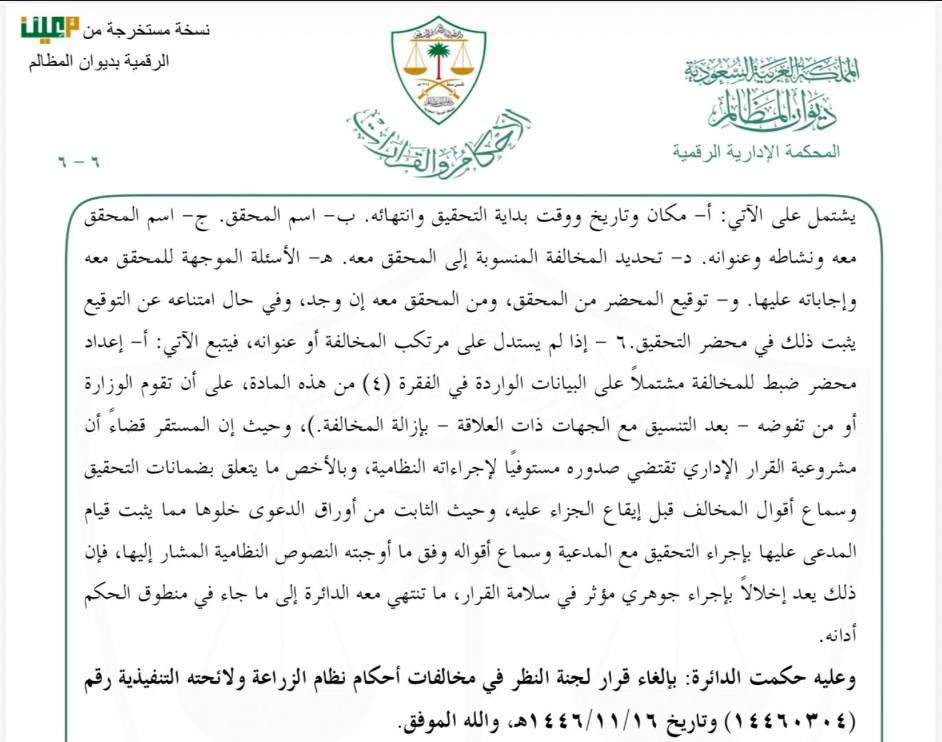
Upon examining the case file, the court found no evidence establishing that the administrative authority had conducted an investigation with the claimant or heard her statements in accordance with the required procedures.
The court held that the absence of proof of an investigation and hearing constituted a breach of a fundamental procedure affecting the validity of the punitive administrative decision, requiring its annulment.
This confirms that the legality of a punitive administrative decision does not arise solely from establishing the underlying violation, but also requires compliance with the procedural safeguards prescribed by law.
Procedural Safeguards in Agricultural Violations
The ruling reviewed the procedures governing agricultural inspectors, including documenting the violation, identifying the person responsible, preparing the violation report, conducting an investigation, hearing the person concerned, specifying the alleged violation and the questions addressed to that person, recording the answers, and documenting all of this in the investigation report.
These procedures are particularly important where decisions result in financial penalties, because an administrative sanction affects the legal and financial position of the alleged violator.
The Legality of an Administrative Decision Is Inseparable from the Validity of Its Procedures
The ruling reflects an important principle in administrative disputes: the validity of a punitive administrative decision depends on both its substantive and procedural elements.
Even where violation reports or documents relating to the alleged conduct exist, they do not replace the procedures required by law to protect the alleged violator’s right to investigation and defense.
Accordingly, once the court established the existence of a substantial procedural defect affecting the challenged decision, it did not find it necessary to exhaustively examine the remaining aspects of the dispute.
Operative Part of the Judgment
The court ultimately annulled the decision of the committee responsible for considering violations of the Agriculture Law and its executive regulations, which had imposed the fine at issue.
The ruling highlights the importance of administrative authorities complying with prescribed procedures when exercising punitive powers and ensuring that the safeguards of investigation and hearing are satisfied before sanctions are imposed.